

How to Recover Data from SSD on Windows and Mac (2026 Guide)

Solid State Drives (SSD) are widely used as storage media in our computers because they can transfer data very quickly. However, recovering deleted or lost data from an SSD is much more complicated than recovering data from a traditional hard drive once SSD is damaged.
One major reason is a feature called TRIM, which can permanently erase deleted files and make recovery difficult if you act too late.
But no worry! This article offers the most excellent approaches to recover lost data from your SSD. Check them all and you will bring back your important data and files.
PAGE CONTENT:
Part 1: Important First Step - Check and Disable TRIM
As mentioned above, SSD data recovery is different and not as easy as other HDD data recovery. One significant factor that affects a smooth SSD data recovery is TRIM.
TRIM is a special command that your operating system (Windows, macOS, Linux) sends to a Solid-State Drive (SSD) when you delete files. It tells the SSD which data blocks are no longer in use, so the SSD can wipe those blocks in the background. However, it greatly hinders your SSD data recovery and increase the failure rate.
Therefore, you need to disable TRIM in advance when you want to perform SSD disk recovery. Follow the steps below to learn how to disable TRIM before SSD data recovery:
Step 1. Open Command Prompt on your Windows. You can search cmd in the Windows Search Box and run Command Prompt as an administrator.
Step 2. Now, you can check the TRIM status. You should input the following command and press the Enter key:
fsutil behavior query DisableDeleteNotify
If it shows 0, that means TRIM is enabled. If 1 comes up, then TRIM is disabled.
Step 3. Now, you should disable TRIM. Input the following command and press the Enter key:
fsutil behavior set DisableDeleteNotify 1
This way, you can successfully disabled TRIM.
Step 4. Now, you can start SSD data recovery in a higher success rate.

Part 2: Best Way to Recover Data from SSD (Recommended)
Now that you have disabled the TRIM function and have stopped using the SSD, you can now start the actual data recovery process.
Recovering files from an SSD is still more complex than from recovering data from an HDD drive or your iOS and Android devices. Therefore, a professional third-party data recovery software is necessary and efficient. Tools like Apeaksoft Data Recovery can scan the drive, and make solid-state drive data recovery easier, even without any previous backup.

Downloaded by over 1,000,000 users
- Deep scan SSD drives to locate deleted/lost files precisely.
- Preview recoverable files before SSD recovery.
- Choose to recover specific files or recover multiple files with one click.
- Support recovering data types of docs, photos, videos, emails, and more.
Secure Download
Secure Download

- Test Environment: Windows 11 Pro, macOS Sequoia 15, mainstream SSD drives
- Simulated Data Loss Scenarios: Accidental file deletion, SSD formatting, corrupted partitions, system crashes, TRIM-enabled/ disabled states
- Photos: JPEG compressed snapshots (10 KB-5 MB), RAW camera photos (20-80 MB)
- Documents: DOCX, XLSX, PDF (20 KB-20 MB)
- Videos: MP4, MOV footage (500 MB-5 GB)
- Audio: MP3, M4A audio clips (1 MB-30 MB)
Step 1. Download and install Apeaksoft Data Recovery on your Windows or Mac computer. Launch it and choose your desired disks. You can choose all disks and click the Start Scan button in the bottom right corner since you need to recovery data from the whole SSD disk.
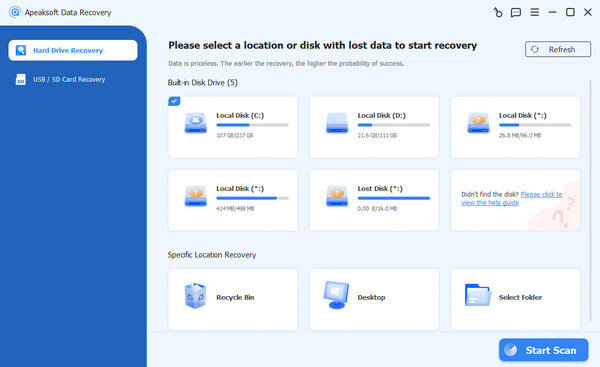
Step 2. This free data recovery software for SSD will start scanning your computer to retrieve all files. Your lost files will be marked in red. During the scanning process, you can already choose your desired files. Then, you can click the Recover button to recover lost data from SSD easily.
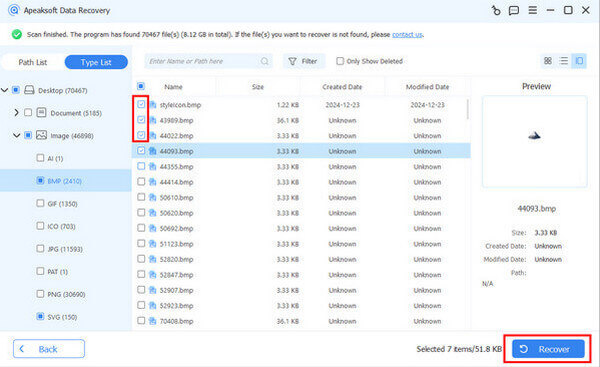
Tips: Please disconnect your SSD disk and connect it to another computer for SSD data recovery.
Part 3: Recover SSD Data Using Windows Shadow Copy
If data recovery software cannot work well, you can try Windows built-in recovery to recover lost data or files from an SSD disk. Windows has a built-in feature called Previous Versions (Shadow Copy) that can restore the previous version of files or folders, thus achieving SSD disk recovery easily. Follow the steps below to learn how to recover data from SSD drive with ease:
Step 1. Choose a file folder that you want to recover lost files within it.
Step 2. Right-click on it and select Properties. Then, click the Previous Version button.
Step 3. If Shadow Copy is enabled, you will see previous versions of your desired files. Now, you can choose your desired one and click the Restore button to recovery the lost files on your SSD drive.

Part 4: Recover SSD Data from Backup Files
If all the methods don't work, restoring SSD data from backups after format is usually the safest and most reliable solution.
Unlike software-based recovery, you don't need to worry about TRIM or SSD data recovery success rate as long as there is a backup.
If you've ever saved your SSD data in Dropbox, OneDrive, Google Drive, etc., you can definitely easily do an SSD data recovery without any effort. Let's take Dropbox as an example to recover lost files on an SSD with your backup. Those Dropbox deleted files can also be recovered.
Step 1. Launch Dropbox and click the Backup button on the menu bar.
Step 2. You can open the backup file folder to select your desired files or file folders or just choose the folder and click the Download button to recover lost files on your SSD drive easily.

Part 5: FAQs About SSD Data Recovery
Can SSD data be recovered after TRIM?
Usually not. Once TRIM clears the deleted data blocks, the recovery process becomes extremely difficult or even impossible. Therefore, you should take action as soon as possible before TRIM runs is the most beneficial strategy.
Is SSD recovery possible after formatting?
It depends. If the solid-state drive is quickly formatted and TRIM has not yet completely erased the data, then the recovery software like Apeaksoft Data Recovery may still be able to locate some information.
Can SSD data be recovered after deletion without a backup?
Possibly. If TRIM has not erased the deleted files and the drive has not been frequently used, then the recovery software may still be able to retrieve these files. Success depends on how quickly you take action.
Conclusion
This article has offered 3 excellent SSD data recovery services you can use on different platforms. You can choose data recovery software for SSD recovery like Apeaksoft Data Recovery, or you can also use Shadow Copy or your preferred data backup and restore tools. Whatever method you choose, you should remember to disable TRIM before doing SSD data recovery, or the success rate will be very low.
Related Articles